
Tell me if this sounds familiar. 1. You sit down in a class/panel/workshop about the hero’s journey. 2. The lecturer/panelists hype(s) up the story archetype and say(s) it appears in all the best stories because it’s something that resonates with us. 3. They proceed to explain the hero’s journey, step by step, using Star Wars or The Hobbit. It makes so much sense, and you totally understand. 4. You go home, grab your favorite story, and try to apply it. 5. You realize you must not understand it as well as you thought, because you can’t pick out all the story beats and your attempts to do so are a mess.
Recently, I read Gail Carriger’s The Heroine’s Journey and realized that there’s another story archetype that has resonated with Western audiences for thousands of years, and it’s the structure behind many of my favorite books, movies, and TV shows. The book was profoundly eye-opening, and I recommend it to everyone, whether you want to write a heroine’s journey or not. (But before you dismiss the idea of writing one, know that Harry Potter, The Hunger Games, and many romance, buddy cop, and team stories rely on this plot structure.)
One fun thing about the heroine’s journey is that not all the beats need to be present, and of the included beats, they can be repeated or used in a different order. So while the plots of different books might not match each other beat by beat like my protectors institutionalized examples did, they should be similar enough that we can see the same underlying archetype.
Here are the beats I’ll talk about here:
- Broken familial unit
- The family offers aid but no solution
- The heroine abdicates power and descends
- Danger in isolation, power in connection
- The heroine visits the underworld aided by friends and family
- Negotiation and compromise
- Reborn familial network
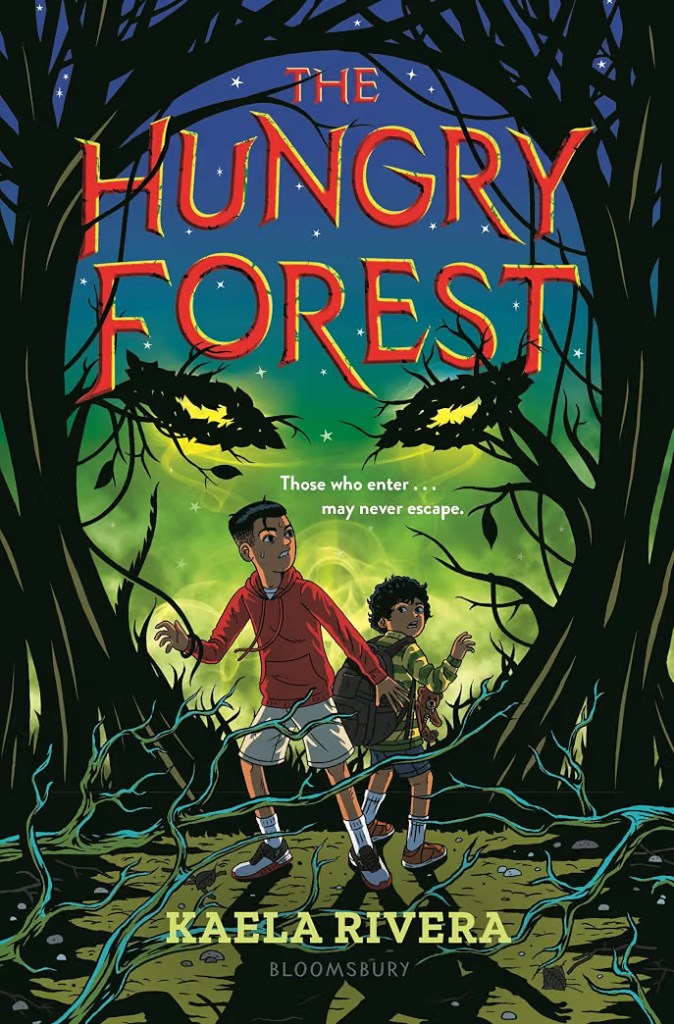
With that, let’s take a look at how it works in one of my favorite recent reads: The Hungry Forest by Kaela Rivera. It’s a middle grade horror about two brothers who get trapped in the woods near their house. They need to get out by dawn or else be trapped there forever.
Broken Familial Unit
Even before the story starts, the boys’ dad dies. Additionally, they spend the first several chapters constantly bickering, and their mom seems to be barely keeping it together. In more ways than one, their familial network is broken.
That’s an important point for a heroine’s journey—the “heroine” doesn’t embark on the adventure because she wants riches or glory or excitement; she’s pushed into it by her familial unit being broken. So while Bilbo Baggins leaves for adventure because—despite his reservations—he wants to, Katniss leaves her normal world to save her sister’s life.
In the case of Ryan and Teddy, our two brothers, they hear the voice of their dad, who they’re almost certain is dead, coming from the forest.
The Family Offers Aid But No Solution
But before that, Ryan, Teddy, and their mom are all trying to work through their grief in their own ways. Their mom’s “exhausted all the time now” (p. 12). Teddy has become obsessed with researching the mysterious forest where so many people have disappeared.
And Ryan tries to be tough, like their dad was, and fix problems like his brother’s embarrassing childishness. He thinks that not crying and not showing fear are ways to honor his dad and prove his love for him.
The three approaches lead to conflict, and none of them have found closure. Anyone can see it’s not working—something needs to change. So the family “offers aid but no solution.”
The Heroine Abdicates Power and Descends
At school, Ryan’s the captain of his track team and popular among his friends, who make fun of Teddy when they can get away with it. Ryan cares a lot about appearances and works hard to keep his perfect.
Like other heroines, to move forward on his journey, Ryan must abdicate his power and status and “descend” into a different world. He leaves his friends in the middle of track practice to chase after Teddy, catching up to him just outside the forest.
That’s when they hear their dad’s voice.
After a brief argument, they make their “descent.” Ryan decides to go in—leaving behind his popularity and control over his life—and Teddy follows. But once they’ve entered, they can’t leave. At least, not without going through.
Inside the forest, they meet a girl named Perdida (“lost” in Spanish and Portuguese). She’s trapped there by the mask on her face, but teaches the boys what she knows about the forest (including that the voice they heard was a monster—not their dad) and promises to help them escape. She’s never succeeded in getting anyone out, but there’s a first time for everything, right?
Danger in Isolation, Power in Connection
A heroine’s power is in her connections, and she’s never in more danger than when she’s alone. A fantastic example of this is Harry Potter. In her book, Carriger talks about how Harry receives help with each task of the Triwizard Tournament, shares the victory with Cedrick and House Cup victories with his friends and fellow Gryffindors each book, and defeats Voldemort over and over again because of the power of love. His connections are his power. On the other hand, Harry discovers and becomes obsessed with the Mirror of Erised when he’s alone and receives new scars while trying to deal with Umbridge on his own.
Back to The Hungry Forest. After the boys have a particularly nasty fight, Teddy runs off on his own and is captured by one of the monsters. He’s ultimately brought to the Brothers, who make the masks that trap people in the forest and turn them into monsters.
In the stretch between Teddy and Ryan are sadistic twins obsessed with deadly games, an unhinged musician, and the Brothers themselves. At first Ryan tries to do things his way and not listen to anyone else. But as he learns about vulnerability and empathy, he’s able to form and deepen connections that allow him to survive and track Teddy to the lair of the Brothers.
Perdida discovers that she entered the forest decades ago to save her brothers, who are the Brothers. No matter how many times she’s tried to save them, they’ve always refused, even going so far as to take away her memories so she can’t keep bothering them. Because of their actions, she’s been isolated, both physically and emotionally. For years. She’s stopped believing in her own worth.
The Heroine Visits the Underworld Aided by Friends and Family
In the climax, otherwise known as “the underworld,” Ryan, Teddy, and Perdida help each other confront the lies they’ve long believed and fight for escape. In a moment of desperation, Ryan puts on the mask meant for Teddy, willing to do anything to protect him. Though he fights with the voice in his head trying to turn him into a monster, he isn’t able to overcome it until Teddy hugs him and tells him he’s not alone. For the first time in the whole book, Ryan cries. He tells Teddy he loves him and he’s sorry, and the mask breaks and comes off.
Together, the boys help Perdida realize that after years of trying to help her brothers, she deserves to leave. She doesn’t deserve to be trapped there because of their bad choices. Ryan and Teddy promise to become her new brothers.
None of them could succeed on their own, but together, they’re enough.
Negotiation and Compromise
Per Carriger, “When you write your heroine in crisis, yes, you can absolutely subdue her enemy, but then she is more likely to turn them to her side, pursuade them to give up, or trap them than she is to kill them. Revenge, glory, the death of an enemy, recognition of accomplishments, or presentation of a boon (while these may occur) are irrlevant to the heroine’s core identity” (p. 98).
Rather than killing or getting revenge on the Brothers, our heroines’ goal is simply to leave. They fight the Brothers only enough to escape them, break Perdida’s mask, escape the monstrous trees reaching for them, and overcome their own doubts. They manage to escape the forest.
Reborn Familial Network
The kids emerge triumphant, all mask-less; the boys are reunited with their mom; they have greater understanding and love for each other; and their mom adopts Perdida, who has been trapped in the forest for decades. Even though they weren’t able to rescue their dad because he really is dead, they have become “a newly reshaped family” (p. 241).
Similarly, The Hunger Games ends with Katniss back home with her sister, and the Harry Potter series ends when Harry’s loved ones are finally safe from Voldemort. Then there’s even a flash-forward epilogue to his newly reborn familial network. The goal all along has been for the heroine to recover what she’s lost, and even if her familial unit doesn’t look the same at the end of the story as it did in the beginning, if it is reborn or reworked, it is still a happy ending for our heroine.
A handful of other heroine’s journey stories I love include Edenbrooke, The Whisperwicks, Big Hero 6, Ophie’s Ghosts, Project Hail Mary, The Host, Frieren: Beyond Journey’s End, The Ghostkeeper, People We Meet on Vacation, Virtually Me, and Upside Down Magic.
Heroine’s journeys are powerful because they remind us to look outside ourselves—to both rely on the people we care about and become someone that others can rely on. They remind us to be brave, clever, vulnerable, selfless, funny, compassionate, and loyal. And when we lack powerful relationships in our lives or we feel alone, these books can become needed friends.
There are many wonderful structures to use while plotting a story (such as the hero’s journey, save the cat, the seven point story structure, story circles, kishotenketsu, and others). I hope you’ll consider adding the heroine’s journey to your toolbox. And who knows. Maybe you can apply it to some of your favorite stories too!


Leave a Reply